Centerbeam: a Seminal Collaborative Work
Fellows’ meetings at the long table in the exhibition room, which included students, junior fellows, senior fellows, administrative staff, and invited scientists and engineers, set the stage. Manfred Schneckenburger had invited CAVS to participate as a group in the 1977 document 6 in Kassel, Germany.
The CAVS community responded to Otto Piene’s request for a common idea. Harel Kedem, a graduate student, proposed a habituate fabricated of abandoned computer-age hardware and software. Piene suggested a diamond structure poised in the landscape that would use various materials and media to amplify the sun’s reflective energy. Lowry Burgess put forth the idea of a water prism complemented by a household of conduits, which he called Centerbeam. The proposals were democratically voted on. Burgess’ was selected.
“I proposed a work in which a very long bundle of pipelines of elements and energies were encrusted with numerous images and informational elements (video, holograms, laser, antennae, mirror, etc.). This woven bundle was to be absolutely straight and level running through the landscape and possibly some buildings. It appeared to me as a living staff of energies, media and phenomena like sparkling notations. (Lowry Burgess, Centerbeam catalog, 1980, 26)
Centerbeam: by Mark Mendel
Centerbeam was in the Dokumenta in Kassel Germany summer of 1977. The following summer we set it up on the Mall in Washington DC. Mostly the same piece but different audience. From an international art crowd to a DC tourist general citizen crowd. In DC people didn’t know or care whether or not it was art. They just liked the high level of jumping, twitching, flashing, technology.
There was Paul and Otto’s sky Opera. All color and inflatable turbulence. We arrived from MIT with a big ass laser and that was before the enactment of laser safety laws. We shot that baby out across the mall at the then new Air and Space Museum, a mating of tech critters.
In the darkness the crowd got deep into the, shall we say, interactive component , flinging their empty silver Coors cans up through that laser space refracting that laser light like Martian Kamikazes attacking with death rays blazing.
Text from CENTERBOOK,
The Center for Advanced Visual Studies and the Evolution of
Art-Science-Technology at MIT
Elizabeth Goldring and Ellen Sebring
MIT School of Architecture and Planning, Cambridge Massachusetts
ZKM Center for Art and Media Karlsruhe, Karlsruhe Germany
MIT Press 2019
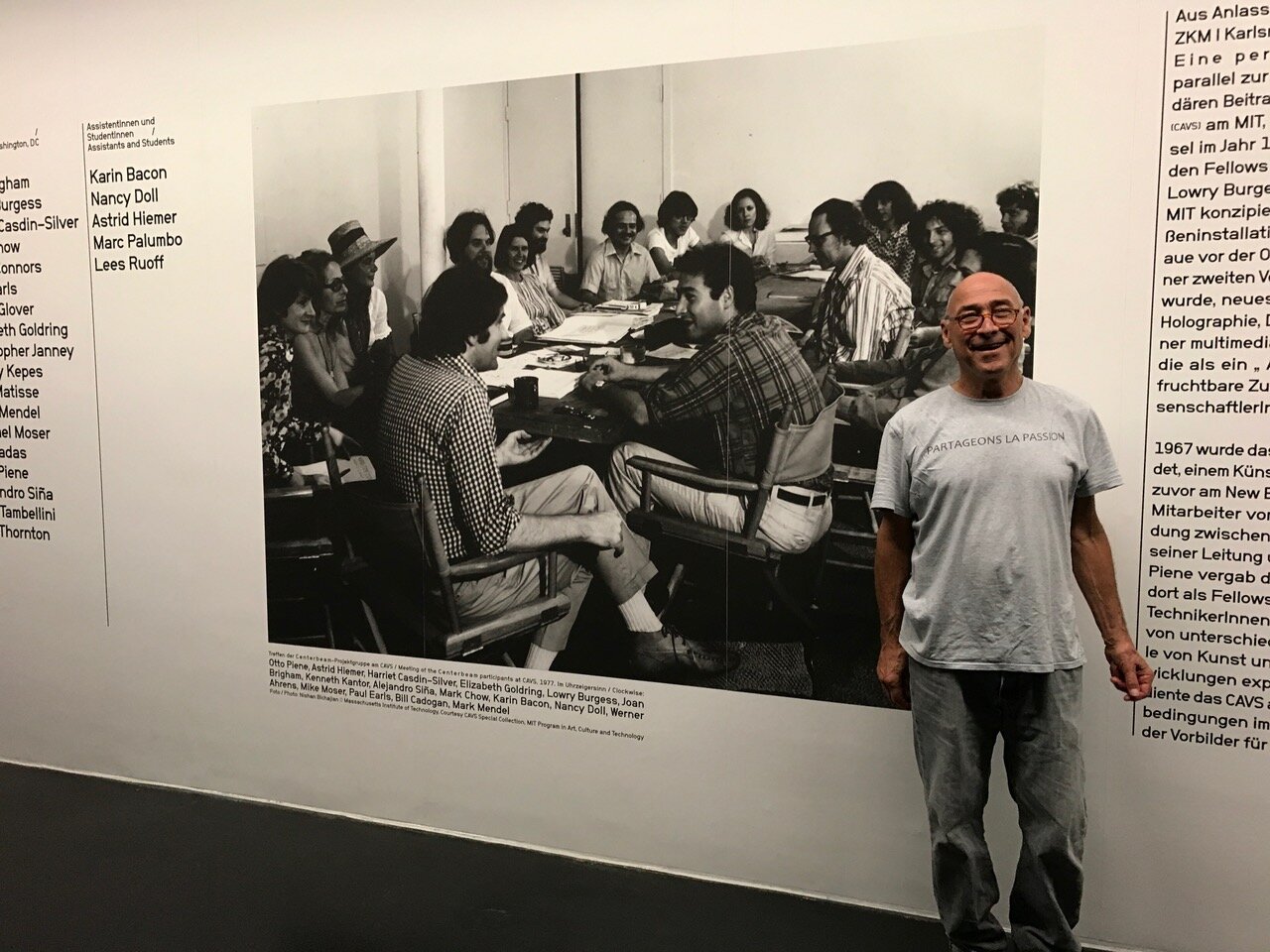
Image on wall shows CAVS-MIT artists who worked on Centerbeam in 1977
Pictured: Otto Piene, Astrid Hiemer, Harriet Casdin-Silver, Elizabeth Goldring, Lowry Burgess, Joan Brigham, Kenneth Kantor, Alejandro Siña, Mark Chow, Karin Bacon, Nancy Doll, Werner Ahrens, Mike Moser, Paul Earls, Bill Cadogan, Mark Mendel
In Celebration of Collaboration
Collaboration was the hallmark of the Center, its essence and its raison d’être. What set CAVS collaboration apart was a communal working dynamic as well as the Center’s location in the heart of MIT. Collaborations forged in the hallways, exhibition room, Pit, and studios of Building W11, often galvanized by invitations for group exhibitions, formed the Center’s collective artistic voice. The kinetic performing sculpture, Centerbeam, as a group work, defined unprecedented ways of collaboration at CAVS. Designed for documents 6 (1977) in Kassel Germany, Centerbeam was called “An Aqueduct to the 21st Century” by Manfred Schneckenburger. (Centerbeam catalog, 1980, 27) The sculpture traveled to the National Mall in Washington, DC, the following year. In 2017, a 40th anniversary exhibition—Centerbeam: A Performative Sculpture by CAVS—was mounted by ZKM, the Center for Art and Media Karlsruhe, to celebrate the seminal art and technology work. This chapter explores CAVS’s collaborative spirit through the works Centerbeam and Monocle as examples of the unlikely partnerships among artists working together within a research institute.